Showing posts with label World. Show all posts

Thursday, September 27, 2018

Humans of New York - Lagos, Nigeria


“I’m studying human development. A few years ago I came across an article that said there were no successful black nations in the world. It really angered me. I thought: ‘Some fellow is trying to run us down.’ But then I discovered the author of the article was Nigerian. And the more I read, the more I realized it was true. And I started to think that maybe we should be mad at ourselves. I always hear my friends complaining about the politicians in this country. I tell them: ‘Imagine that lightning strikes and suddenly you’re the president. Would you know enough honest people to form a government?’ And they freeze. Because our culture doesn’t ascribe a premium to honesty. People will laugh at you for being honest and broke. Nigeria has the highest concentration of black people in the world. So this is where it should happen. But development doesn’t begin with things, it begins with people. I’m not saying that self-criticism is the answer. But it’s the beginning of the answer. Maybe we should be a little less proud and a little more discontent. Maybe we should stop blaming our immorality on poverty. I grew up in the slums and I don’t want to hear it. Don’t blame it on colonialism, nepotism, racism, or any of the ‘isms.’ And don’t blame it on the slave trade. Because slavery didn’t begin with white people. White people purchased slaves from our shores—that’s true. But black people did the selling. And we were paid for what we sold.” (Lagos, Nigeria)
A post shared by Humans of New York (@humansofny) on

My (edited) response to the above post and various comments from people about the validity of his opinion, his experience and HONY's right to share his story:

'Reading the majority of comments from people who are actually from Nigeria leaves me disinclined to disagree with this man's perspective and ultimately it sounds like what he's trying to say is that where people can make change and take responsibility for their future, they should, in spite of what has happened in the past. That's how positive change and forward movement work. 

It's also oddly condescending reading some of the statements of those who disagree, almost like they don't believe he can know his own country and own mind. I mean, if that's what you think, ok, but maybe give the guy some credit without immediately assuming he's a brainwashed simpleton. 

Lastly, for anyone decrying this story being shared at all? The world is full of stories, experiences, opinions and ideas that may or may not be in line with yours, that is reality. Hiding from them or avoiding them doesn't help anyone learn anything. Engage, disagree, argue, do whatever, ignore if you really must, but they have a right to be spoken and shared, just like any of your own opinions, opinions that might seem equally as heinous to someone you may have never met and whose life is nothing like yours.' 

Sunday, July 29, 2018

On my brain's recent vacation to the world of Cosmology

When I thought of the above title for this post just now, it seemed a somewhat clumsily inadequate metaphor, but now as I think more about it, I have always associated my vacations and holidays with a broadening or rebirth in perspective and a resulting eagerness to learn more and that is exactly what this last week has been for me so I think I'll run with it.

A few months ago, a friend of mine lent me two books, both of which I somewhat hurriedly finally consumed in the last week because she asked for them to be returned for other friends to read. I'll ignore my regretful complacence in not reading them sooner and as it happened, I was (now in my opinion, quite fortuitously) able to finish both before finally returning them to her last week. 

Both books were fascinating beyond measure and allowed me to go on the journey from the intricacies of the Cosmos all the way right down to the complex ecosystem of the Gut. I adore the fact that the mind has such capacity for travel across such different worlds and on that concept alone, I imagine I could write a whole other post, although for now I've decided to narrow it down to the first book and its ongoing and wonderful aftermath - Astrophysics for People in a Hurry by Neil deGrasse Tyson

This is an incredible book about a subject I've always loved. The Universe and all its mysteries have always fascinated me on countless levels - the sheer size of this mysterious entity in which I somehow reside, the scale of such a thing in reference to Earth which in itself is a mass of histories, concepts, beings, and everything we could possibly imagine and more; the billions of galaxies and billions more celestial bodies and objects that reside within it; the composition, evolution and sheer beauty of all those objects; the capacity to see, observe and learn from them all... I could really go on, but ultimately, it is an area that I and millions of children before me have always looked upon with such awe and interest.

Incredibly, I just remembered one of my favourite literary encounters as a kid. There is an Aussie book called My Place in Space by Robin Hirst and Sally Hirst. In it, a little boy and his sister are catching the bus home and when asked by the driver where they live, the boy says, 'Home.' When the driver mocks him for not providing an address, the boy then proceeds to give the most epic address ever. 

Ok, I've now literally just re-looked up the book  and purchased it on my phone and am in the process of re-reading it. The edition I've found is an updated edition which now includes Pluto's change in status from a planet so thankfully the book is still accurate and only goes to show the continuing evolution of our scientific knowledge. Another update I've noticed that I think I have correctly remembered, is that now Henry and his sister both contribute to the address where previously it was just Henry talking while his little sister sort of just did funny things behind him. It reads a tad clunkier if you remember the original, but is a nice change, particularly if it does encourage more little girls to feel less left out by notions of Astronomy. 

Returning from that brief but fun detour into one of the likely roots of my personal interest in space (mind travel is awesome, no?), I've since read a fair amount about astronomy and astrophysics. I took an Astronomy Gen Ed course at uni, I've read books, I've watched documentaries and read tons of articles, however as years have passed, my overall retention of information has been pretty poor because despite being an area of intense interest, it has been far from one of any real personal focus. When I get to read about, I read about it, that's it. I have had to live life, work and of course focus on things of more importance than my own wish to broaden my cosmic understanding. 

Then about two years ago, a friend of mine introduced me to the star gazing app on her phone. It hadn't yet occurred to me to search for an app to let me do this and it was awesome. That evening, we sat on top of her Coogee rooftop and looked at the stars and planets in a way I hadn't really done since my Gen Ed observation nights. Unfortunately, at the time, I didn't have enough space on my phone so when I downloaded the app, it kept crashing and I ended up having to delete it. It wasn't until April of last year when another friend mentioned his own app whilst telling my friends and I that Jupiter would be visible that I attempted to download the app again, this time on my newer phone. Since then, I've used the app and enjoyed the added convenience of getting to engage more with the Night Sky and more particularly in the last few months since I've begun taking more photos of the various planets on my phone. 

In the wake of this recent resurgence of engagement and interest, reading deGrasse Tyson's book has been one of the most enjoyable things I've done this year. That is not an overstatement. I loved it so much. He takes the reader through the fundamentals and the history and he did so in a way I found so surprisingly comprehensible after other books have left me completely dumb and overwhelmed by how little I understand and how much more I have to learn to simply understand a sentence. Don't get me wrong, I still had a few moments like that while I was reading the book, but overall, I found each page fascinating and found that it all made some form of logical sense to me from one concept to the next. While taking me along the cosmological journey through time, space and theory, it explained concepts that I had previously held vague ideas about, like neutrinos and the lengths and functions of the different waves. It re-introduced me to planetary trivia that I'd long forgotten, like Jupiter's vital role as our protective Big Brother. It allowed me to finally get jokes I'd heard on TV about spherical chickens in a vacuum (frankly, this book made so many Big Bang Theory references suddenly make worlds more sense!) and it gave me insight into everyday things I knew existed, but hadn't fully understood, like the fact that InfraRed and UltraViolet were the bookends to ROYGBIV. Reading this book was the most fun I've had in a long time while learning so much. 

This, combined with my most recent shift in overall life objectives and plans, particularly around reading much more and writing much more, left me with a brain thrilled and primed to find out more, to fill in the gaps that the book could not possibly cover if it were to be aimed at 'people in a hurry'. One of the most fascinating points he makes in the book is how much everything we learn only leads to more questions and more debates between the experts in the field, highlighting that science isn't so much filled with indisputable facts as is so often over-simplistically touted, but rather a field rich with ongoing theories, tests, findings, analyses, questions and debates and constantly reminding us of what we know and don't know. 

Due to my literally being 'in a hurry' to finish this book and the other lent to me, I moved on to the world of the Gut straight after, but having finished that the day I finally returned both books, I have looked up more reading and decided to delve into an area that would make sense for me to look into considering my own personal beliefs, the relationship between Cosmology and Theology. I ended up on this excellent page in the Stanford Encyclopedia of Philosophy by Hans Halvorson, a professor from Princeton. Brilliant read leaving many papers to read in its wake, I highly recommend it. It does an awesome job of laying out the historical cosmological models and the various arguments put forth by many of the field's minds, past and present, regarding these models' relationships to the notions of theism and atheism. Again, a cornucopia of debate and insight (often leading me to turn to Google for some of the concepts that once again baffled me!) that again highlights that concepts that have been widely accepted are still being challenged, like the Big Bang, which is challenged by both Loop Quantum Cosmology and String Theory. Of course, even taking the Big Bang as the prevailing model, interpretations of its either confirming or not confirming the existence of an omnipotent creator also vary and the debates go on. 

The more I read, the more I want to read, and so I shall. I'm charging myself with a lot here, but my brain is enjoying every second of it and only feels more energised by its sojourn into the astrophysical world to fill its existing knowledge gaps by embarking on a better acquaintance with the basics of Physics. Youtube has proven a fun start considering visual demonstrations of motion and force better aid my physical and spatial comprehension. When I got home last night, after getting briefly distracted by a TED Talk on Organic Chemistry, I ended up on the Crash Course about motion in a straight line. Then this morning, I ended up going on a fun journey through the principles of flight, Bernouli's Principle and existing questions around that principle, Newton's Third Law of Motion, the means for travel into space and ultimately ending on a thought experiment about removing the existence of Time (not the man-made measurements of time, mind, rather the sequential nature of events). For just this Sunday morning alone (worthy of a whole post in and of itself, which I fully intend to start after I take a break), I'm grateful to Mr deGrasse Tyson and to my friend for lending me his words in the first place. 

I'll end this post with another video I watched this morning of the man himself on the Late Show with Colbert. 


His energy is infectious and his final point is a really good one, but admittedly, it's not one that will keep me up at night so much as it just reminds me that as much as we can know, there will always be something else, something new, something missed and while that can be disheartening for some, I see it as simply a statement of reality. Our limitations will always exist and we will only ever be able to grasp what little we can but what we have grasped thus far is endlessly fascinating and always will be and therefore provides only more motivation to keep searching, learning and shifting what we need to shift - just as we did when we found out the Earth was round, when Germ Theory was discovered, when we learned that the Universe was expanding as opposed to being in a steady state, when we learned about subatomic particles, when we learned that Pluto wasn't actually a planet... and basically every other time paradigms shifted. On personal, individual scales, we often find we have to do this all the time and while I couldn't possibly begin to have deGrasse Tyson's level of perspective on the matter, I tend to find that what we understand about our more visible, more immediate world constantly shifts and I keep having to incorporate that understanding into my perspective and any resulting attempt at a worldview. I've undergone countless 'paradigm shifts' in my own character and I know this will only continue with time and experience and I have faith that those entrusted with the search of these bigger answers will have the capacity to survive and learn as they have always done. 

This is why I love science and this is why I love life. 

Saturday, March 25, 2017

The History of the World, Every Year


What an amazing video - I was pretty much glued to the screen for the entire 20 minutes. It will require a good few re-watches to get a hold of the things you miss while trying to keep up with everything that happens, y'know, in analysed recorded history, but they will be just as captivating, surely.

An incredible job by the people involved. Trying to picture the timeline and everything that eventually pulls together to create the tapestry that makes up a life, the history of a single human being, is a huge enough endeavour, let alone the movement of every single human through time.

Looking from the outside and then diving as far and as deeply in as possible only continues to emphasize the beautiful and insane complexity of the world. It would be amazing to be able to Dr Manhattan view it all, but hey, these kinds of videos are a pretty great glimpse.

Cheers, History.

Saturday, August 13, 2016

Unity Through Laughter - So Fluffy!!!


I seriously want as many people to watch this video as possible - the more useless stereotypes and preconceptions dead, the better (although may the humorously benign ones live forever! I can't take a world where an Arabian prince can't be in possession of a real life tiger and one ideally named Rajah).

Love this guy and genuinely love what he's trying to do with his work - it's a hell of a balance being able to remain genuine, truly hilarious and culturally sensitive without completely ignoring cultural differences and ultimately being able to highlight the humour in all of it.

Salud Gibril!

Wednesday, July 27, 2016

A response to fear in light of all that's going on in the world...

We

There is little else to do but continue.
Let the music play on
The words write themselves
And the smiles shine on.
Fear is a friend, not an enemy
It reminds us of what we have
What we could have
Who we could be
It only becomes a foe if we let it
If we allow it to consume us
To blind us to what's true and good
And keep us from doing all we can
Being who we can be
Even then, it isn't the fear that acts
Or doesn't act.
It is us.
We make the choice.
We are the cause.
We.

******

As most who know me would be very well aware, fear is the consistent underlying aspect of my character. There's no lie in my ease or in my laughter or moments of joy, there simply exists an acknowledgement that either hovering alongside or not far beneath is that little stratosphere of anxiety and doubt that has been formed over three decades of often hyper-sensitivity, over-awareness and an unrelentingly vivid and dramatic imagination.

Saying that, I still think the world is just as scary as it's always been, simply with more coverage. What I can't control, I can't, but because I'm often mired by the fear I so feverishly ramble on about above, it's too often easy to just allow the burial to take place and sink into dead mode. Not a difficult thing to do when I picture the people I love potentially being slain as they innocently go to Mass in the morning as they do every day and when I think of family members already lost having simply gone to do their job to provide for their family and, through no choice of their own, never come back. Fear throws aside realistic probability of risk or the fact that others have lived their entire lives this way and allows the notions to grow beyond proportion making me even 'happier' to sink into nerve bending oblivion.

The above is just a brief reminder that it is no excuse. I've always been of the opinion that my life is no one else's fault but mine and so I continue to think that way, fear notwithstanding. Atop that, is the broader reality that, so far as I'm concerned, my world is also no one else's fault but mine. I acknowledge the impact of other's choices but my responsive actions will always be mine and mine alone and for that I will always hope to take ownership of everything I choose and do and, following that, everything I inflict upon the world.

Now, to put some of that fear-taking into action, I post. Regardless of its triviality, putting anything up on this takes a chunk out of me and truth be told, I know of it garnering little impact, whether it be negative or positive. It is simply here and it is simply me. For the purposes of what I do on this thing, that is enough. I understand those who question that but truly, I assure you, the purpose is vital... in the absolute purest sense of the word.

Anyway, here's to ensuring that the sense of helplessness doesn't lead to actual uselessness in the face of all the crazy in the world.

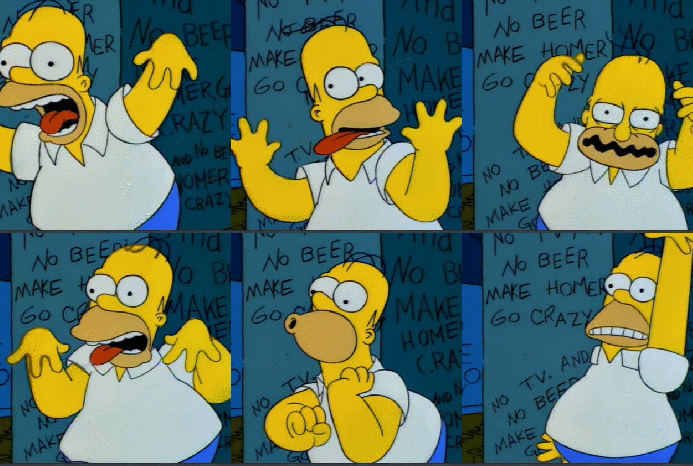
Or... we could just go full Homer, a clearly viable option.

Sunday, July 10, 2016

War

It's strange to be so brashly titling this post considering the lifelong fear I've held on the subject. You could say I was a dramatically fearful kid and when I was about 7 or 8, I came across AJP Taylor's The Second World War - An Illustrated History in my brother's room and after that, my fear of kidnappers and cyclones swiftly turned into a fear of armies, soldiers and dictators.

I won't pretend I read the book in its entirety because I certainly never did however as the word 'Illustrated' would suggest, there were a great many pictures in it and many of those were intensely traumatising to a young kid. Sure, the rather comic pictures of propaganda from during WWII were almost a form of cartoonish relief, but I ultimately got the gist of just how horribly the world suffered between 1936 and 1945 and that new information was terrifying.

Not to mention well timed. In 1990, I was 7 going on 8, and much as I tried to avoid the news, I wasn't ever able to escape the reports of what was happening in Iraq and Kuwait and joining the growing mini-encyclopedia of horrors I was slowly constructing inside my head (thanks to Mr Taylor) were reports from the news, the newspapers and our monthly Reader's Digest, of the atrocities being committed by Saddam Hussein and his army. A measure of how deeply internalised this information became is a dream I can still vividly recall in which an Iraqi ship had somehow made it's way all the way to (the dream version) of Sydney Harbour followed by my dad and myself being taken prisoner and being lead onto the ship. Thankfully I woke up before anything drastic happened but I continued to live each day battling fear about a war that was happening on the other side of the world.

Then of course 1992 came around and the war in Yugoslavia broke out, the subject of which is the reason this post has come into existence. By '92, my consumption of new articles and stories of various wars had unfortunately increased and again my very sensitive young mind was not so well equipped to handle the footage of bombings and people huddling from snipers in Sarajevo. I cried a lot that year about the people in Yugoslavia and, being a kid, really only understood that Serbs = bad. My Year 3 teacher at the time happened to be Slovenian and her attempts to explain the conflict, whether she meant them to or not, only confirmed for me that the Serbians were the bad guys.

I remember reading about the 'Romeo and Juliet of Sarajevo' (again, likely thanks to Reader's Digest) and wondering why, why, why would the sniper have taken the shot. Did he not know that the boy, Bosko, was a Serb? Did he not understand that if Bosko could love their 'enemy', maybe there was no reason to kill them? I know now that it was never determined that a Serb killed the two but I wasn't to know that back then and all of it just felt senseless. Later in high school, I would end up reading Zlata's Diary not too far followed by The Diary of Anne Frank, and hating the level of innocence that had to suffer at the hands of powers who simply did not care.

As I write this, I'm suddenly reminded that the reports of this kind obviously never ended, but, as this article I found from 1994 states, they simply changed places. Mixed up in amongst the stories and reports from Iraq and Yugoslavia, were the reports from Rwanda and learning that Hutus and Tutsis existed. It was just ongoing and alongside the more fun things that Buzzfeed likes to remind us of about the early '90s, these are things that I also associate with that time.

Yesterday and today, I ended up Wiki-ing the siege at Sarajevo, realising that I still didn't really have a complete idea of what happened at the time. Even before I'd ever set foot in Europe, something that still sets off a ping in my mind is when people have referred to or spoken of Serbia and Bosnia as 'amazing holiday destinations' because my immediate association is a war which somehow still feels recent. Bearing that in mind, I decided to look it up and here I am, slowly recalling bits and pieces that I'd read at the time and filling in more of the gaps.

I associate all of the conflicts mentioned above with the pre-9/11 world - a world which as of late, I'd begun to see with the rosiest of coloured glasses. 9/11, the wars that followed in Afghanistan and Iraq, the terrorist attacks in Madrid, London, Mumbai, the civil war in Syria and the rise of Islamic State not to mention the increasing frequency and spread of attacks, these things have inevitably led to thoughts of just how far flung the world is. Of course, it's not hard to feel that way in the face of the current state of the world and our increasing ability to see it all happen as it happens.

But then I read again about events like Sarajevo and quickly remember, alongside the aforementioned concurrent conflicts, things like the constant reports from the Middle East, Rodney King and the LA riots, the earlier bombings in NYC and the World Trade Centre, the shootings in Port Arthur and Dunblane and of course later, in Columbine and remember just how often I thought the world was 'dying' back then, too. These days, the nature of news and social media only means we hear about more incidents more quickly so it makes sense that the world could be just as bad as it was back then, only we're reading and hearing more about it now.

And that notion could be further supported by the fact that, despite wherever we are now, the world is probably at a point where most 'civilised' countries aren't all at open war with one another. Unlike the centuries prior. With the recent Brexit and discussion around the efficacy and the purpose of the EU, it still amazes me that a set of such closely packed countries that have easily spent the last two millennia at war have lived in relative peace since the end of WWII. Barring, of course, the former Yugoslavia and the recent Russian annexation of Crimea and infiltration of Ukraine.

I now wonder how naive a notion that is in itself. The Middle East continues to rage on, Afghanistan is still tattered by violence, the South China Sea only continues to simmer, Venezuela is in the process of civil collapse, Boko Haram continues to tear Nigeria apart, extreme racist groups are growing in popularity, just to name a few things... we don't all have to be bombing one another to be destroying one another.

But honestly, the conclusion I end up drawing, if you can even call it that, is similar to that of the article I linked earlier. This is the world's curse. I grew up with the above, my parents' generation were doing nuclear attack drills in their classrooms, my grandparents' generation endured the world wars as did their parents, and so on.

So I'm going to out and out disagree with anyone saying the world is more screwed now than it's ever been (multifaceted topic, I know, but in terms of global and territorial conflict, I'm going with it and from the looks of things, Google agrees with me, reliable bastion of knowledge that it is). It's just behaving as it always has. People will always want power, territory, identity... and there will always exist those who decide to kill to get them, the sad truth remaining that innocent people will be the most numerous casualties. It's difficult to end on a positive note after such a conclusion and particularly considering this all remains a very real personal fear, except to acknowledge and genuinely appreciate the fortune and privilege in which I get to live when so many needlessly suffer purely due to an accident of birth.

In the meantime, to lighten this just a touch, something I read on Cracked a couple years ago - 18 Undeniable Facts That Prove the World Is Getting Better. Sure, it's a little US-centric, however entries 17, 12, 7, 2 and 1 do garner cause for hope.

Saturday, January 16, 2016

A lovely moment, courtesy of YouTube and the very awesome Woltersworld

One of my favourite channels on YouTube is Woltersworld, run by Mark Wolters. A taste of his simple, but awesomely informative, brand of travel advice is below. 


I'm not much of a commenter on YouTube these days, but I genuinely enjoyed this video (as I do pretty much all of his videos, which I discovered in a bout of reminiscence upon my return from Germany) and I was also recently back from my most recent trip to the Philippines which only intensified my burgeoning obsession with travel so, in answer to Mark's question posed at the end asking viewers what they loved about travel, I answered as per the comment below... and received the loveliest reply.


Though he does actively reply to many comments, I was still genuinely touched to receive such a heartfelt reply and even more so to be told that my words were a source of support and motivation for his continued work. 

However brief, honestly such a nice moment among the flood of crazy that is the interwebs. 

Saturday, April 04, 2015

On the notion of Belief: Do Science and Religion really have to be incompatible?

'Science and religion are based on different aspects of human experience. In science, explanations must be based on evidence drawn from examining the natural world. Scientifically based observations or experiments that conflict with an explanation eventually must lead to modification or even abandonment of that explanation. Religious faith, in contrast, does not depend only on empirical evidence, is not necessarily modified in the face of conflicting evidence, and typically involves supernatural forces or entities. Because they are not a part of nature, supernatural entities cannot be investigated by science. In this sense, science and religion are separate and address aspects of human understanding in different ways. Attempts to pit science and religion against each other create controversy where none needs to exist.'


I do encourage everyone to read the rest of that page linked above.

Earlier today, the I Fucking Love Science (IFLS) FB page posted a link about what happens to you if you happened to give up sugar for Lent. I'm always somewhat wary of seeing links like this on IFLS, not because I'm not religious, quite the opposite, but because I've become accustomed to the hostility and mindless bashing that comes with even remotely daring to have the notions of both science and religion in the same vicinity. I have seen it before when IFLS linked to an article talking about the potential discovery of the birthplace of Jesus. Now I understand that IFLS and any similar sites are not The History Channel or otherwise historically informative, but when I see comments like, 'Why are you reporting on a myth', I am filled with a very quiet but very real fury (look up the history for two seconds, honestly). On today's post about sugar addiction that dared to mention Lent, some choice comments included, 'If you practise Lent, there's already something wrong with your head' and 'do people who fucking love science observe Lent?'.

Clearly that first comment is far more incendiary than the second which, outside of my own bias and doubt, could have been genuinely meant. In that case, I will answer it with a resounding yes. Some people who fucking love science actually observe Lent because they are both scientists and Catholics or Christians. In fact, growing up, the majority of priests I knew were scholars in science, most notably physics. Even now, some of my friends who are scientists and engineers are also very devout Catholics who have no problem pursuing science and practising their faith at the same time. Bearing further mention are the countless Christian or Catholic scientists who have contributed so significantly to our modern understanding of the world. How many people know who Georges Lemaitre, Angelo Secchi or Roger Bacon are? Look them up.

[On a personal note, I am a happily practising Catholic with a Bachelor of Science in Psychology (although one who admittedly chose not to pursue it as a career but professionally assists others who have) who agrees wholeheartedly with the use of the scientific method to learn more about the world around us. Any qualms I may have with scientific pursuit usually fall under the umbrella of scientific ethics (an area into which I undertook postgraduate study), often in the area of bioethics (eg. cloning), but such areas are generally contentious and without medical or scientific consensus so I'm far from alone on that count, religious or not.]

Essentially, what is upsetting and angering about comments that immediately jump on the science and religion can't coexist is that these days, some such declarations (not all, I'm sure, but many) are made without having actually attempted to read or research the idea and appear to have become Pop Fact, much like the notion that religion has caused the most wars (again, fury) despite the fact that according to recorded history, only 123 out of 1763 wars and less than 2% of all people killed in warfare have been classified as religiously based, according to the Encyclopedia of Wars by Phillips and Axelrod. Yet, people seem more than willing to blindly accept that religion is a bigger source of evil than outright human greed and territorial conquest and the need for power and control.

Also, from experience, a lot of people who seem to 'love' science, have no damn clue what it actually is. As a Psych student, I was often told by people I knew in the hard sciences that 'Psych is not a science' despite the fact that the method by which I spent a degree being taught to study observable human behaviour was most definitely the scientific method and the statistical analysis that followed (which I have gladly left behind) was engaged to ensure we were obtaining results as statistically significant as possible. We didn't do that shit for fun, we were trying to see if the variables we had manipulated in order to test our hypotheses were actually making a real difference - just like people do in labs. Pardon us for trying to scientifically research something that is intangible and therefore more difficult to assess. To this day, I say those studying cognitive psychology are some of the most creative people I've ever encountered. Being able to construct experiments to test and observe memory? Insanely imaginative and clever.

But I digress. As the statement made above by the Academy of Sciences points out, scientific reason and faith and belief look at things from completely different angles and ultimately, that's how you want to view the world - from as many angles as possible. Considering we live in an age obsessed with pluralistic thought and perspective, it's odd that people are then only willing to engage in understanding the world via one very often flawed means. When journalists investigate a story, attacking it from just the one side or the one perspective, it begs questions of bias, an agenda and a lack of objectivity. Why is it suddenly completely objective to stand by science and nothing else?

I think what people get confused is scientific fact versus scientific discovery and possibility. More likely than not, what many people take on board as scientific 'fact' is nothing more than the replicated results of studies that provide evidence for particular conclusions to be drawn. These are not facts, they are findings that potentially support hypotheses and once disproven or falsified, will be altered. As an undergrad science student, I was trained to write, '... there is evidence to suggest...' ad nauseum. Even in areas of more solid and tangible results, for example, biological or medical discoveries and treatments, there are only so many treatments, medications and therapies that work 100% of the time. As a sufferer of a number of chronic medical conditions, I can at least personally attest to the fact that many treatments that have worked on many past patients have not been able to work on me and I am not alone in that at all. When it comes to science, we do what we can with the knowledge that we have and still test what works and what doesn't. The rest, we take on almost as a form of faith, eg. I have never seen these medical results in others for myself, but I have taken it on faith that the medical community backing these assertions aren't simply lying to me. In that same spirit, I have never been to space, seen the moon's surface for myself or seen the Red Spot on Jupiter with my own eyes, but I have faith and trust in those astrophysicists who have done the research for me.

Now, if someone has no belief or has chosen not to believe in the supernatural (I don't, however, tend to adhere to the notion that anyone chooses what they believe. While specific beliefs can be altered, belief in itself is simply that. You believe something or you don't), then fine, if you have no room for any form of spirituality in your life or are happy in the notion that biological or neurological processes or quantum mechanics are enough explanation for the more intangible aspects of life, then by all means, that is absolutely your call. This does not, however, give you the authority to declare as fact beyond a shadow of a doubt, that those who do believe in a supernatural aspect of the world are either dead wrong and intellectually pitiable because in some cases, the likelihood will be that those people have put a lot more thought into it because that which is intangible bears far more need for thought by nature of its invisibility.

I do understand that there are people out there who have thoughtlessly decided to follow one belief system or another, among them Catholics and Christians, however, this type of believer is not strictly bound within the arena of religious faith. There are blind adherents to scientists, philosophers, hell, nowadays, even celebrities (I'm looking at you, Jenny McCarthy, incidental anti-vax champion. More fury).

Rather than demonise, however, as I've always stood by the notion that everyone believes what they do for a reason, whatever reasons they may be, at the end of the day, by all means, disagree, mock, even, if you really must, but maybe once in a while, instead of burrowing comfortably in your warren of disbelief/belief, ask someone you just do not understand - why?

Sunday, January 18, 2015

A very, very true article I read and wanted to share...

Plane crashes, terrorism, random violence - new realities amid our relative security 

by Waleed Aly

From the article:

'Here's the thing: in our streets, in our bank accounts and in the air, we in Australia lead about the safest, most secure lives of any people. Ever. Our real income is up and the road toll is down (the lowest since 1945, by the way). We live without any genuine prospect of political strife. We're not about to be invaded or bombed with nuclear weapons – our most feared enemies have knives and guns, not armies in tanks. We're not likely to be decimated by some disease or virus – Ebola or otherwise. Yes we have problems, but they're the kind most of our species could only have dreamed of having. And yet that's so easy to forget because there's this continuous, churning fear.

Our mortal selves aren't under threat, here. But the myths we've built about ourselves very much are. The myth that our addiction to alcohol is innocently, endearingly larrikin, for example. Or that the problems of the world – like Russia's incursion into Ukraine or the disaster of Iraq and Syria – have no call on us and simply don't raise their heads in Sydney or Paris. Indeed the myth – that incidentally underscores how cheerfully we'll slash foreign aid – that we can set ourselves apart as (largely uninterested) onlookers: that the world is a sideshow to which we'll occasionally buy a ticket, but not our society.'

It has certainly been a hell of a year.

As I've already had my rant about Islamophobia, I'm not going to repeat myself on the matter. What with Martin Place, Charlie Hebdo, the continuing horror in Nigeria (which, if magnitude were measured by media coverage, one would assume only involved a handful of victims as opposed to the hundreds more people and the ongoing nature of the onslaught), alongside the sheer reach of news nowadays, Islam has never had a higher profile. 

{{ If anything, as always, what follows these sorts of events is a pretty decent display of human nature's extremities - those calling for the death of all Muslims, beating their chests about how these attacks prove without a shadow of a doubt that all Islam is the root of evil, etc, etc. Then you have those who immediately jump to the defence of all Muslims (not a bad thing) and attack those who would dare to say anything potentially critical and citing agendas left, right and centre, without a glance at the victims and the perpetrators. }}

Ultimately, however, it can't be denied that our existence down here in Australia could not be more sanitised - whether it be by our sheer historical youth (something only made more glaringly clear on my recent trip to Europe) or our cultural propriety, though we certainly bear scars from the inevitably deep wounds endured by any colonised country with an indigenous population, as the article stated, we are a country neither plagued by real famine, violent social upheaval or any kind of real threat - or even experience - of invasion. Though our freedoms are flawed, one could argue that that is more to do with the very flawed nature of freedom itself as opposed to our country actively oppressing us in ways that could ever begin to compare with places like North Korea or Russia.   

In terms of our exposure to active bouts of violence or even visual displays of real carnage, our news coverage is clearly censored or otherwise plastered with warnings of 'graphic images'. We barely see real live active horror onscreen, let alone in real life. Compare this to Filipino news where, when I watched it for the very first time, they were covering a story about a road accident and as the camera panned over the scene, I watched mindlessly for a few seconds before having to blink and exclaim, 'Is that a dead body? Is that the guy right there? Oh my gosh!' The dead man was clearly there on the screen, still, mangled, bloody and completely uncensored. My eyes, so much more accustomed to footage of fully zipped gurneys or camera shots aiming just that inch over from accidents courtesy of Australian news, were wide with shock and horror. And that was from a news report. Of a road accident. 

The next news item was actually worse - a case of escalated road rage in a country not only in possession of guns, but hot and high temperatures. The images in my memory are somewhat fuzzy, but the most outstandingly clear image is of the men actively shooting at each other at surprisingly close range, protected only by ducking behind their vehicle doors. Again, I was shocked. Although again, this was still just footage of a crazy road rage incident. 

Essentially, though the media insists on telling us that we are becoming desensitised to violence and gore in society, this doesn't include one very particular form of desensitisation - the kind that comes with actual personal experience. Outside of those who have come from countries filled with turmoil or those who have travelled to fight, work or live in such countries, the most people down here have had to endure are occasional bouts. 

This is not to diminish these events as real, shocking and genuinely frightening events - to this day, thanks to Wade Frankum and his shooting at Strathfield Plaza in 1991, 23 years ago, though it has weakened significantly over the years, I still experience hesitance when thinking of going there. For years, it made me wary of Strathfield in general. Sure, you could blame my childish naivete for such fears but even now, at 32, some of it still remains. After 23 years. Hell, 18 years after the fact, the words, 'Port Arthur' are still kind of chilling, all thanks to Martin Bryant. 

But at the end of the day, a large part of why these incidents are so shocking is because they still stand out as relatively rare. We compare ourselves to places like America and we feel secure in the fact that that stuff just doesn't happen here. Australia's last high profile hostage taking was in 1984, 30 years ago (though there have been a few incidents in between, it is still a very small number over a 30 year spread). Compared to the number of reported shootings in the US alone, we're doing a lot better. These incidents are rare, which adds to their level of horror. 

Whereas in other parts of the world, this sort of terror is a way of life. Syria, Iraq and Nigeria could not stand out more right now. Or how about Afghanistan, Pakistan, or Eastern Ukraine, just to name a couple more. In places like these, the possibility of raids, kidnappings and straight up slaughter is actually a part of every day living. 

Life is nothing at all like that here in Australia. Not one bit. And true, this has led to the degree of separation many down under feel from the rest of the world's woes. And true, this sense of distance from those harsher realities was shaken, a lot, on December 15 last year as we all watched as those hostages stood with their arms raised against the windows of the Lindt Cafe in Martin Place. And truly, it all did not feel like something that belonged here in Sydney, least of all at Martin Place in the Lindt Cafe, but watching it unfold, the myth to which Aly refers took a solid beating.

Now the bigger, more widely (if subconsciously) perpetuated myth that needs busting? That events of any kinds like these belong anywhere.